(in)Visible - The Artisans Behind the Fabric
[Read until the end to see the final work at the exhibition]
Being invited to respond to textile art exhibition themes can be a little daunting. I think it’s because I overthink it, a bit like someone testing out the water with his/her toes, while another person at the back is shouting, “Just jump in!”. This time, the latter was batik advocate Tony Sugiarta of aNERD Gallery. He approached me early this year to respond to his exhibition theme, mancapat (pronounced manchapaat) - Mancapat: An Expression of Life Through the Art of Batik Tenun Gedog
Mancapat is a “set of hymns that reflects the Javanese philosophy of ‘sadulur papat kalimo pancer’ offering a cosmological worldview that guides the Javanese throughout their lives. Starting from the east as birth or a new beginning, life progresses clockwise towards maturity, death and rebirth.” This philosophy is also reflected in the production of the batik textiles from Kerek, Tuban, East Java, Indonesia.
Responding to Mancapat
In an ideal world, I would have loved to visit Kerek to witness the traditional textile production, and learn about the techniques from the artisans. However, we were fortunate to learn about the life cycle of the textiles, the philosophy and the community through the artist on-line sessions arranged by aNERD Gallery and exhibition partner Sekar Kawung Indonesia, piqued my interest to learn more about the place.
Three of the things that stood out for me were:
The Tuban community’s belief in the guardian spirit of the production cloth, Nini Towok, a granny whose image is immortalized on the face of the moon. She works her spinning wheel to send cotton yarn as moonbeams from which the weavers of Tuban work on. Being the initiator of the fabric cycle of life, the women make offerings to her before beginning the weaving process.
The life cycle of fabric production from cotton seed planting to weaving is local, and does not travel outside the community during production..
The artisans involved in the production of the cloth are solely women.
Reflecting on these points, I wanted to produce an art piece that:
Illustrates the repetitive and labour intensive nature of the fabric production;
Brings an intimate connection between the user and the Tuban community, something which is currently lost due to the rushed lifestyle we now live; and
Embodies the spirit of Nini Towok
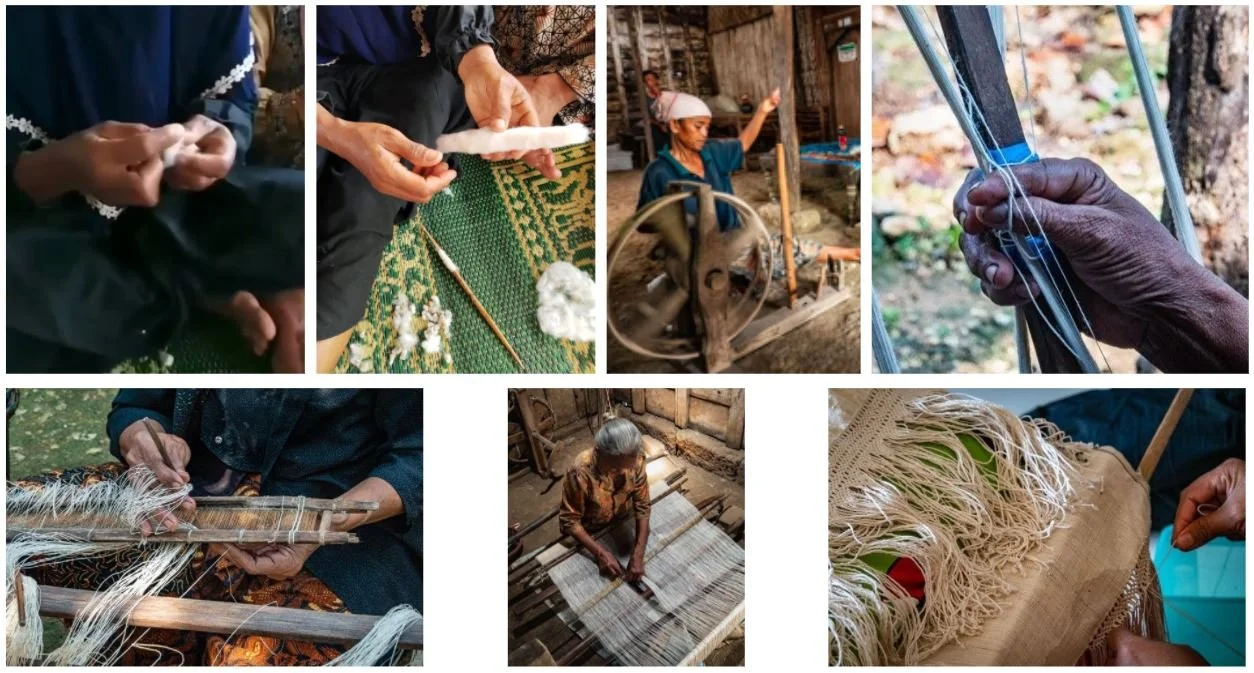
Images courtesy of Sekar Kawung Indonesia
The Hands of the Artisans
I decided to showcase the hands of the ladies in order to communicate points a) and b) above. One of the first questions I asked myself was, “why not the faces instead?”. Well, there are 2 points that came to mind:
Faces are usually a façade that people hide behind, and most, if not all people, put on their best side when being photographed.
Hands reveal more about the person as the former are altered and worn physically through the work that is done. For example, I wanted to highlight these features through the shape and lines of the hands.
Art Process
Selection & Sketching
The first stages of the process involved coordinating and collating the images of the artisans’ hands that were taken by Sekarkawung Indonesia. This was, what I would say was the comparatively easier part of the process. There are up to 10 stages in the textile production at Tuban, and I decided to focus on 6:
Cotton picking
Spinning of cotton
Brushing and stretching of cotton yarns
Preparing cotton on the weaving loom
Weaving
Macrame, a finishing technique unique to Tuban in the production of fabric in Indonesia.
I referenced these images to create sketches.

Free Motion Embroidery & Hand Stitching
The next stage involved embroidering the hands onto fabric. As I was in Hong Kong and unable to access my existing textiles, and due to concerns of shipping times during COVID, I decided to buy the base fabric instead. For this I chose a cream linen base.
To recreate the textures associated with the lines, calluses and to define the form of the hands, I found that using free motion embroidery as the main technique was not sufficient. In the end, both machine embroidery and hand stitching was used, with hand stitching being the predominant stitch to bring out the textures of the hands.


The colours chosen for the project have meaning and are in Tuban’s ideological system of colour combinations for batik:
White - regeneration / birth
Red - motherhood
Blue - grandmotherhood
Materials for stitching
Cotton yarn in the colours white, indigo, beige (naturally occurring) from Tuban (courtesy of Sekarkawung Indonesia)
Olympus red embroidery thread. Red cotton yarn from Tuban was unavailable at the time of the project.
Olympus sewing thread

Arrangement of pieces
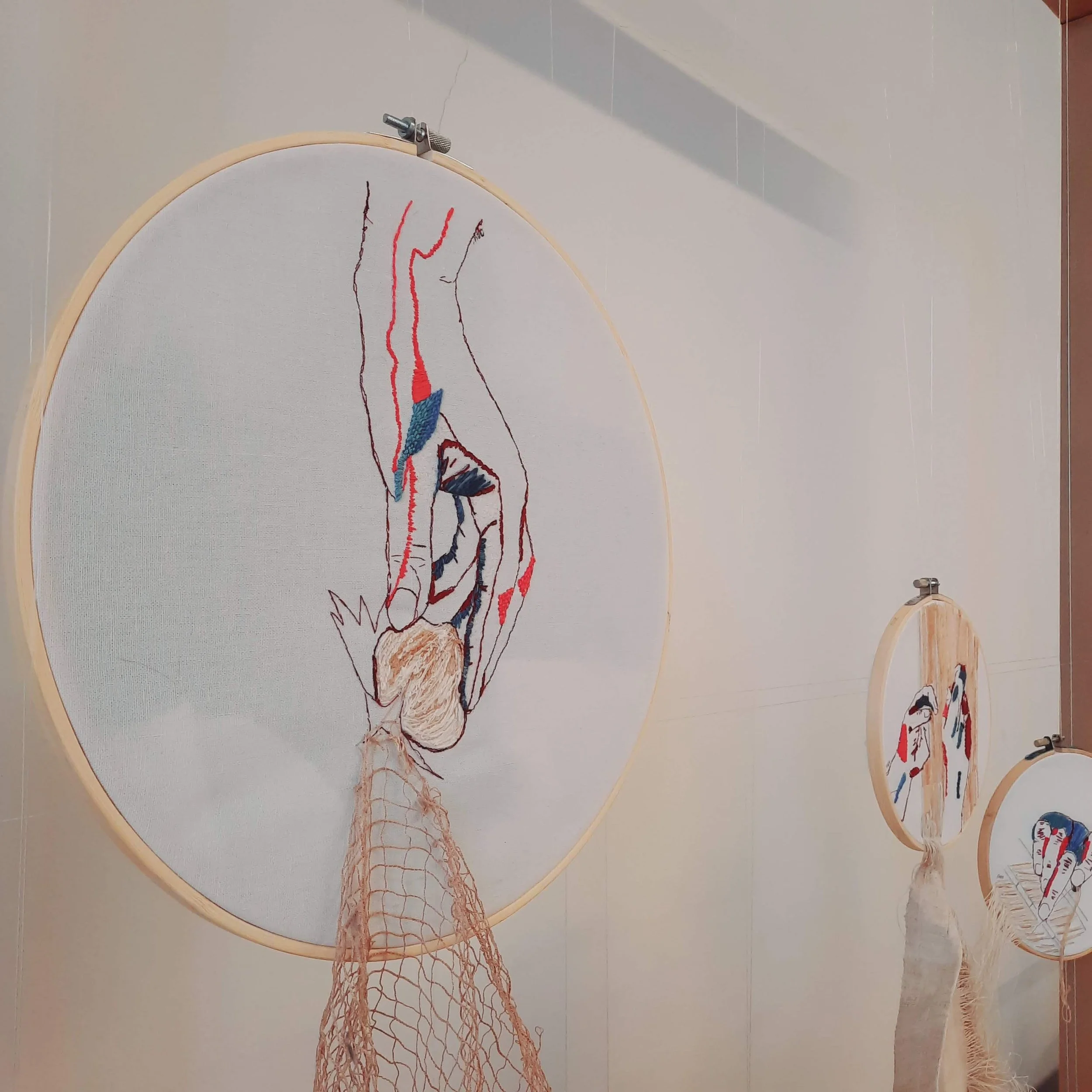
Once all the hands (6 hoops) were completed, the final stage of the project was to create the center two pieces of fabric that connect the hands together. This represents not only the connected artisan community, but showcases the fabrics as an extension of the artisans’ labour, continuing their narrative and that of Nini Towok’s:
The first piece fabric was created using the sewing machine on dissolvable fabric and the beige cotton yarn from Tuban.
The second piece was a tight woven piece from Tuban. I had made a special request for the piece to be unfinished with macrame on one end and loose warp ends on the other.


The hands were arranged in a circle surrounding the fabric as an homage to Nini Towok, as metaphorically speaking, this guardian spirit sets in motion the life cycle of the woven fabric, and in so doing, allows the artisans to share that and their narrative with us.




(in)Visible
When looking at the process of making Batik Tenun Gedog in the Tuban community, textile artist Agatha Lee ‘Agy’ was 1) intrigued by the many labor intense and repetitive steps required; and 2) fascinated by the number of hands that contribute to the farm to wardrobe production. However, when picking up such a piece of fabric, these points may not come to everyone’s minds.
(in)Visible brings to light the Tuban artisans from the picking of cotton to adding the finishing touches with macrame. The artist explores and highlights the features of the hands involved, each pair permanently altered by wear and tear through the repetition of the manual work required. With the use of hand and machine embroidery, and cotton yarn from Tuban, the art piece gives hints to the artisans’ identities, providing the viewer a closer, more intimate connection.
2021
Technique - hand and machine embroidery
Materials - natural fibers, cotton yarn
Mancapat: An Expression of Life Through the Art of Batik Tenun Gedog is organised by aNERDgallery and Sekar Kawung Foundation and is supported by National Arts Council Singapore, Indonesian Embassy in Singapore and Bank Indonesia.
4 - 12 Dec 2021, 12-8PM (Fri-Sat), 12-6PM (Sun-Thu)
Stamford Arts Centre, #02-02
Free admission, Safe Management Measures apply.
Reading list:
Nini Towok's Spinning Wheel : Cloth and the Cycle of Life in Kerek, Java; Rens Heringa
The Face of Traditional Cloth Tradition of Tuban Society, East Java, Indonesia, Volume 16 Issue 1 / Pages.56-69 / 2018 / 2508-3023(eISSN), Ciptandi, Fajar (Dept. of Textile Craft and Fashion, Telkom University) ; Sachari, Agus (Dept. of Textile Craft and Fashion, Telkom University), The Costume Culture Association (복식문화학회)