
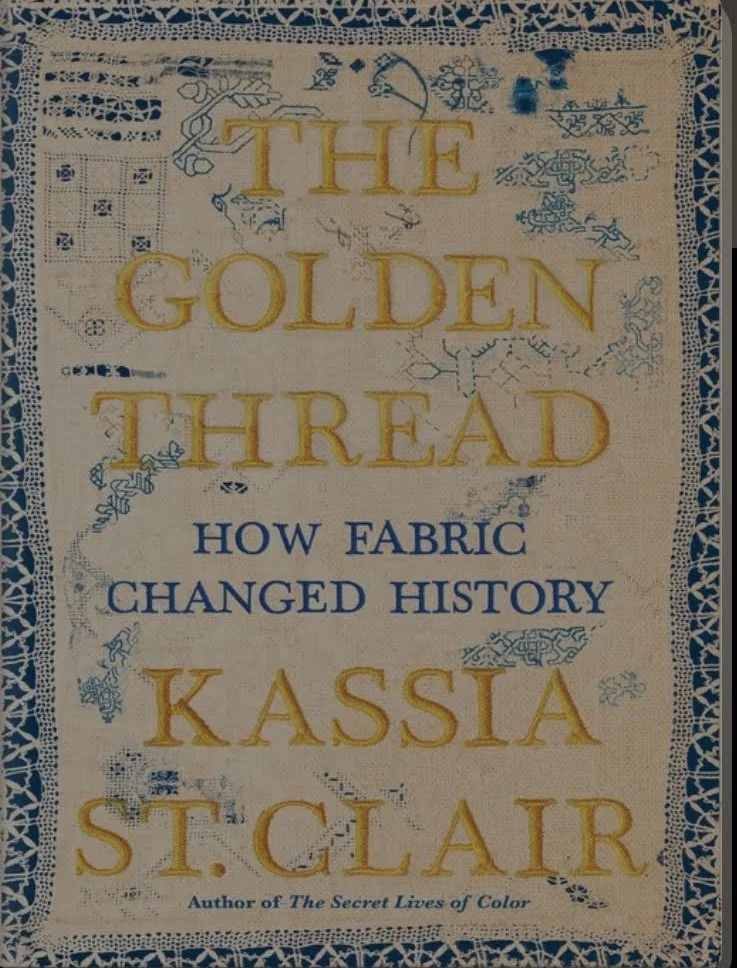
The Golden Thread: How Fabric Changed History
Clothes make the man, English proverb, 15th century.
As my child takes the next step closer to adulthood, he puts away the white shirt and trouser uniform that has defined him for the past four years. Everyday, this set of clothing has given him his identity as a student, and now that he no longer needs to wear it, what will make up his new “uniform” as he enters the next phase of life? Everybody’s new workwear for the past 2 years has given us a new identity too - working from home. While I type this post, I am wearing loungewear, and you might be reading this in something comfortable too. For some of us, our clothes provide comfort, and give us our identity, perhaps some sort of armor masking who we really are. But not many of us know the significance of textiles. It is the woven cloth, as Kassia St. Clair emphasizes in “The Golden Thread: How Fabric Changed History”, that has enabled humans to survive on this planet - providing warmth, keeping bodies cool in hot weather, and even keeping out moisture during a winter trek.
“Clothing would have been one of a suite of skills - including the ability to make shelter and fire”
How Fabric Shaped the World
The Golden Thread: How Fabric Changed History is divided into stories , a nomenclature used for chapters in the book. The book details how clothing may have been essential to life, but it has also heavily influenced and shaped the world we live in today:
The English language is now sprinkled with words and phrases, such as, “unpick”, “unravel”, “weave together”, and “spinster” that are associated with the woven cloth and textile-related crafts. And do you remember the fairy tales from your childhood? There is the pricking of the finger on the spindle of a spinning wheel in Sleeping Beauty, and Rumpelstiltskin spinning straw into gold. Can you think of others?
Fabric has influenced (and still does somewhat to this day) social standing, gender and race, from the use of linens in the ancient Egyptian mummification process of nobility, to the adornment of lace in Europe and silk in China to display one's wealth and status. St. Clair also dedicates a whole chapter to the story of cotton and the global slave trade. To be taken away from the only home they knew and sent faraway to work the cotton fields was cruel enough, but to have their identity stripped away and only be allowed to wear clothing suited to their status is beyond demeaning.
“One of our sins as a nation [is] the way we insulted [the slaves] in sin finery. We let them dress too much. It led them astray, We will be punished for it” A southern lady, overheard in a South Carolina hotel, 1862.
3. Making fabric is itself a technological feat, right from making the first needle from bone to weaving in caves. It has shown the ingenuity of humans. St. Clair mentions that “Fibers obtained today have a diameter of between fifteen and thirty micros; the mean diameter of ancient Egyptian fibers is fifteen microns. Somehow, the methods used by the Egyptians allowed them to separate the bast as thoroughly as the best modern machinery”. Our hunger to “discover” and create new textiles to meet man’s needs has resulted in being able to send man safely into space and land on the moon, enable athletes to swim faster and better, resulting in world records being broken, and even weave fabric from spider silk.

Fabric and the Workforce
Throughout the book, we come to understand that the creation of textiles (be it cotton, linen or wool) and the associated textile skills are immensely labour intensive. St. Clair tells us how it took the Viking community, the equivalent of ten years’ labor, to make sailcloth, sailors’ clothing and bedding for a Viking cargo ship and its crew, from an estimated 114 pounds of wool. In fact, the majority of those involved in working with textiles were women, and it was with textile skills that women were given the opportunity to alleviate family poverty while being at home.
By the early 19th century, however, the industrial revolution and the invention of the Jacquard loom, spurring mass manufacturing, and moving textile making from the home to the factory floor. Poor (and sometimes unsafe) working conditions and low wages was and is a commonplace in textile manufacturing. I was very disturbed by the chapter Workers in the Factory: Rayon’s Dark Past which describes the synthetic fabric’s horrendous history of forced labour, and hazardous working conditions that went unchecked. And did you know rayon is made from plant fibers, and is also another name for artificial silk, viscose, bamboo or modal?
With society’s advancement, we would have expected working conditions to have improved; ironically, the inventor of rayon, Dupont’s advertising slogan 1935 - 1982 was “Better Things for Better Living …… Through Chemistry”. Sadly, with today’s hunger for fast fashion, the human cost is still high. Rana Plaza, which housed garment factories supplying retailers such as Walmart and Primark, collapsed and killed over 1000 people in 2013. It serves as a reminder that our choices have a far reaching impact, on those that produce the clothing, and also on our environment.
Do I recommend this book?
Yes, I definitely do! As a textile lover, I would want to read this book again. There is a lot of information and I appreciate the amount and depth of research that St. Clair did to bring this book together. However, her writing has made it a riveting read, and as a textile artist, the book makes me appreciate the work that has gone into developing the fabric that we know today.
What I did not like about the book
The majority of the book has a huge emphasis on textiles in the Western hemisphere (except for China and silk) and so is not a comprehensive history. It would have been interesting to include the rich textile history of other parts of the world such as batik and weaving in South East Asia, Africa
Have you read this book before? Let me know your thoughts!