
The Memory of Trees Collection
Torrential and unpredictable rain has put a dampener on anyone who wants to enjoy their summer holidays in Singapore. I was caught in a fierce storm during my regular walks along the coast near my home. The blistering winds blew leaves onto the ground, creating pretty patterns, but there wasn’t time for me to enjoy it considering I was getting soaked. I popped down the next day and rediscovered different shades of green on the trunk of trees in the neighbourhood garden. The warm fuzzy layers of green on the bark are either algae, mosses or lichen. I think the ones I saw were moss, thriving in a moist environment and trying to penetrate every crevice of the bark.
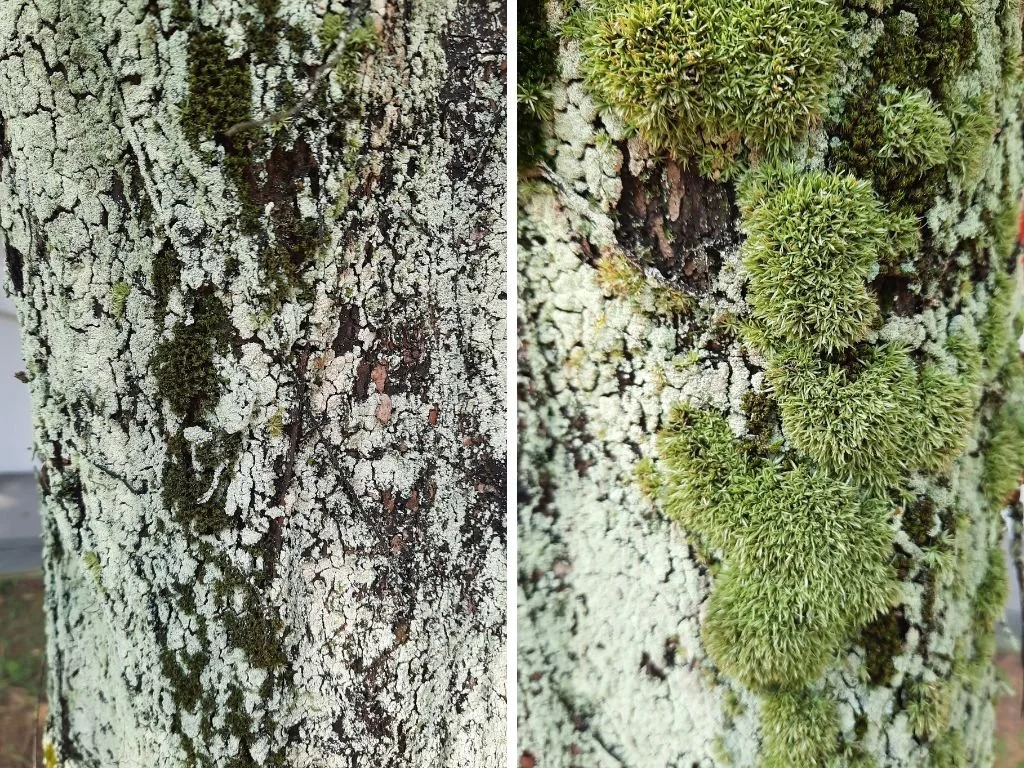
Tree bark after a rainy day
The Beauty of Tree Bark
There is something beautiful about tree bark, its colour and its texture. Flakey, rough, smooth, scaly - each tree has its distinctive bark signature, created through years of growth as the tree’s wood pushes up against the outer bark. Tree bark will have witnessed many pressures from its surroundings too, such as herbivores, insects and parasitic plants, the temperamental weather, pollution, and of course, us humans! How many of us have mischievously used a pen knife to carve our names onto a tree trunk, expressing our undying love for another, or climbed up a tree?
Slow Fashion, Slow Living
I first explored tree bark in my previous work for Singapore Eco Film Festival in 2017. At the time, I had collaborated with a local woodwork design studio to create an interactive coffee table series, and when I was also exploring natural dyes. When I was approached by Ee Peng of slow fashion house You Living 悠.生活 for a collaboration, I thought it was timely to look at bark again.

The Memory of Trees Collection
I wanted to create something that represents what You Living stands for, and that is slow living:
Slow Fashion: As an advocate of sustainable fashion, You Living carries the slow fashion items of Taiwanese artisan, Cheng Hui-chung of Cheng's Atelier. Cheng weaves his own cotton and flax fabric, as well as non-toxic dyed material to create a series of garments that are classics and don’t follow trends. This way of making clothing follows the slow movement / lifestyle philosophy which I strongly believe in.
Inner-Tortoise: Nature also evolves at its own pace. Trees grow slowly, mature, and experience so many things as they develop from a seed into an adult tree. The bark gives the tree its unique look and signature; no two trees are the same, and I wanted to impart this onto the garments.
Memories Last Forever: Did you know that the word cortex in latin means bark? The cortex is the outer layer of the human brain, and holds our older memories. Likewise, the bark is the outer layer of the tree, and similarly, it holds the memories of what the tree has witnessed over the years; the changing landscapes, the scars from nature’s wrath or human’s desires.
After a series of discussions, we decided to come up with a wearable series that incorporates my artwork. This comprises an exclusive and limited edition series of brooches, and a top.
You Living had also brought up the pre-order model in our discussions, and suggested that we take this approach inline with their philosophy of slow living and slow fashion. But first, the creation of the designs and the art process!
The Art Process
Observing
Earlier on in the year, I had already taken a series of tree bark images, and sketches. There are so many different types of tree bark in Singapore (as you can see in the images). But the one that captured my heart was the one that allowed the growth of moss and lichen on its bark. The juxtaposition of the grooves of the bark and the ridges of moss and lichen were what interested me, and how they could live in harmony. It didn’t seem that the trees were in any way harmed by the growth. And by the time it was extremely sunny again, the growth would disappear and, revealing the skin of the tree.

Tree bark in Singapore
Making Marks
As part of the process, I took several implements (some from the neighborhood garden and some from within my studio) and made marks with acrylic paint and textile medium on the fabric. I didn’t want to copy the tree bark marks directly from the images. I wanted to emulate how the tree bark evolves over time and ages as it is pushed and pulled by the pressures of the growth of the tree, and the environment. The direction of each mark, the pressures and its shape were influenced by how I felt at that point of time. I also employed the same techniques on the Cheng Atelier tops. I knew I wanted to continue the same slow philosophy that Cheng had employed throughout his artisanal practice, but also to replicate the marks that are made over time on a tree bark.
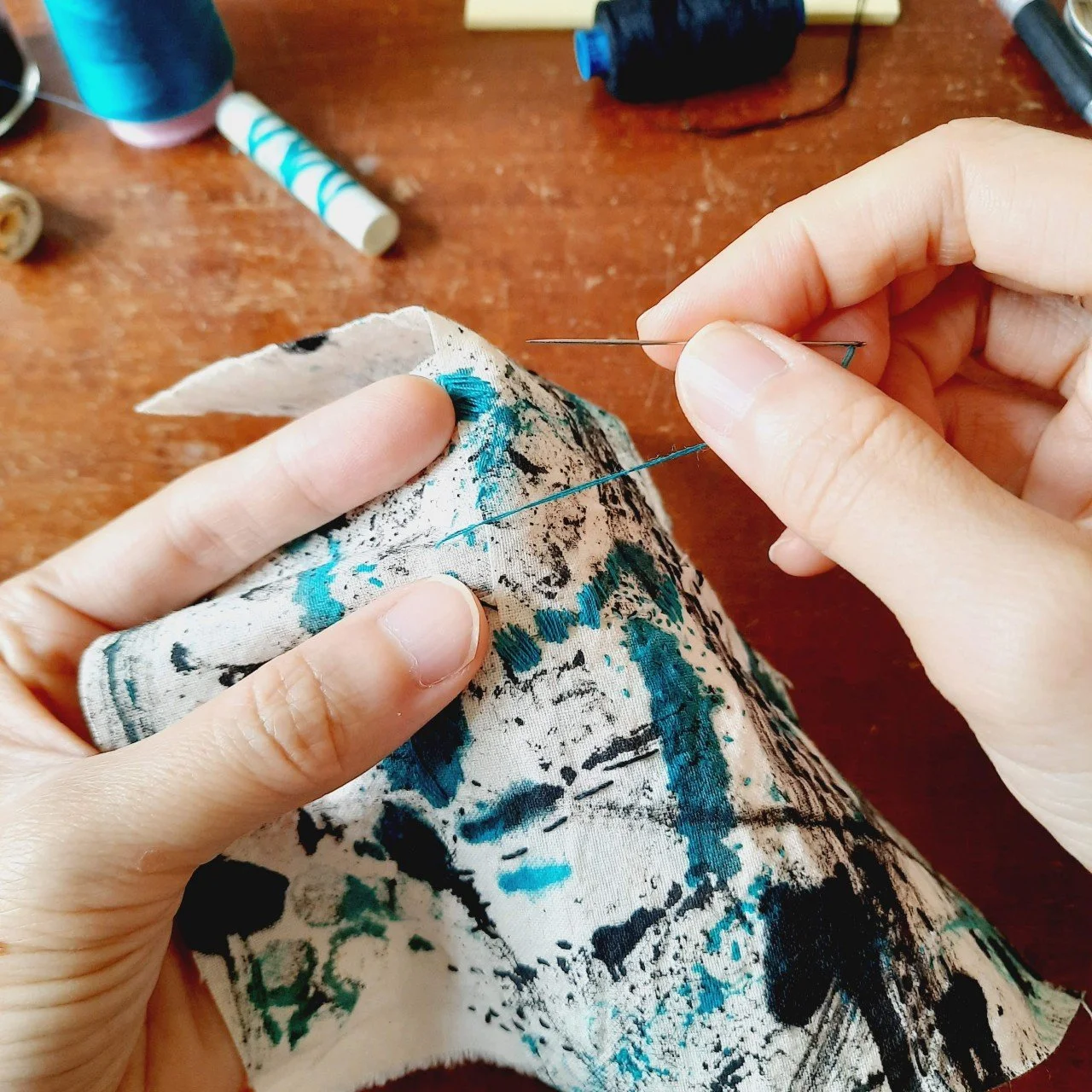
Creation of the Brooches
I then cut the pieces up and stitched them back together again with free motion embroidery and hand stitching. The act of cutting and stitching represents the scars and the healing the bark faces throughout the tree's life, while the paint and the layers of stitching represent the textural surface of the bark. These pieces were used to create an exclusive 12 piece series of brooches.

Marking the Tops
After applying the paint on the tops, and allowing them to dry, they were then embroidered with various threads to replicate the bark, in particular the rough and smooth areas that co-exist on its surface. In order to maintain the minimalistic nature of the top, I decided not to pack the top with dense stitching. There is a choice of 2 designs - black or blue.


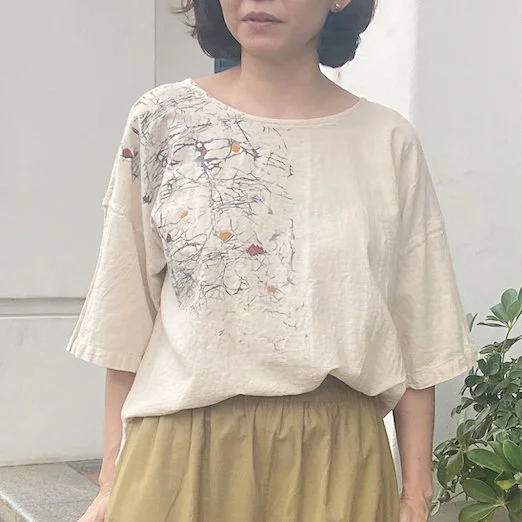
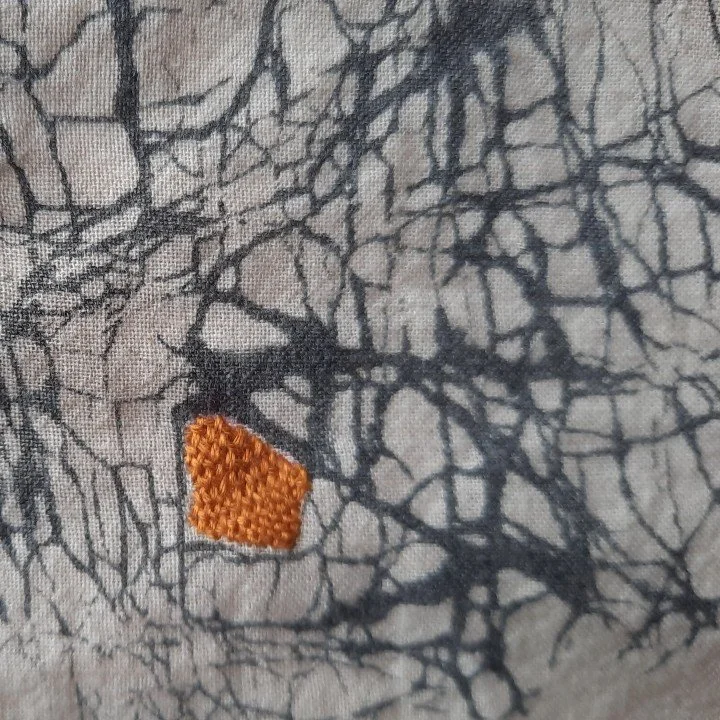
Launching on 23 September! Preorder is over
Thank you for everyone’s support
The Memory of Trees Collection comprising a limited edition of 12 brooches and garment will be available from 23 Sept until 31 Oct at the You Living showroom.
The garment collection will be available for pre-order from 23 Sep - 31 Oct.
The pre-order process takes ~ 4 - 8 weeks. The construction of the sustainable garment begins with the weaving of the cloth from cotton and linen, and treatment with plant enzymes. After its construction, the garment will be delicately painted and embroidered on by Agy.
If you wish to try the fit, samples are available at the You Living showroom.
Showroom address:
28 Perak Rd, Singapore 208145
Open Weds - Sat, 12 - 7.30pm
About You Living
Designing women’s, men’s and unisex apparel from breathable, eco-friendly materials, Singapore-based brand You Living 悠.生活 creates and curates collections that pay homage to minimalism and the natural world. With a name derived from the Chinese word for carefree: 悠 (pronounced ‘You’), the local label offers wardrobe staples that celebrate skillful tailoring and effortless silhouettes. Whether dresses or easy to style separates, each piece is designed using sustainable practices, like the use of 100% natural fabrics; eco-friendly dyes which minimises land and water pollution.
Post note: I was thinking about the name of the collection and as I was preparing and writing this post for the launch, I remembered that Enya had a song of the same name, The Memory of Trees, and it had a beautiful meaning behind it:
In ancient Celtic belief trees had spirits within them and were considered sacred. They were the keepers of memory and lore. The Druids, the men of knowledge, used to record their wisdoms by means of a secret alphabet called Ogham, which is also called the "Tree Alphabet". Ogham is named after the God Ogma, the God of poetry and eloquence. Thus the memory of trees looks into the past.
The future we look at may give us another interpretation of the title, with the destruction of the world’s rainforests it may turn out to be that the memory of trees is nothing more than that for us – a memory.
NOTES BY ROMA RYAN
ONLY TIME: THE COLLECTION, 2002