Atomic Habits for Artists
I’m so happy to say goodbye to 2020 - 2022.
Last year was a year of trying to figure out what was going on with my health. I had moments when I couldn’t venture into my art studio, even though it was literally in my home. I wasn’t able to activate my body and mind, and this resulted in moments where the work was harder to produce. It was like a huge elephant parked itself in my body and refused to budge. I had lost confidence.
My doctor initially thought it was the start of depression. But after a few sessions and seeing other symptoms crop up (e.g. insomnia, which I’ve never had!), I was referred to the local menopause clinic for perimenopause. Perimenopause is the period leading up to menopause. This series of events can occur at any age, and not necessarily when you’re in your late 40s. I didn’t know what to expect until it hit me - I wish I had learnt about or had been made aware of it; I would have loved to be prepared and anticipate the symptoms. All I knew about perimenopause was hot flushes, a symptom that I don’t even get!
The most serious of symptoms I experienced and were affecting my life were:
a) A sudden lack of confidence in anything I did. I had a lot of self-doubt. This in turn led to creative blocks.
b) Anxiety, and would feel all weepy at the tiniest of things. My partner said I was totally out of character.
c) Days of insomnia - it’s not great to be tossing and turning in bed, and then have no energy to work in the studio the next day.
d) Feeling overwhelmed by everything and not knowing where to start
I had managed to nail down the issue, and now it was a matter of understanding my body, and managing my day around the symptoms.
Atomic Habits - What Would an Artist Do?

In the beginning, I tried to go back to my usual routine, but this was not helping me at all. My body had changed, I had had changed, so it was obvious, my routine had to as well. I had to get rid of behaviours that were not helping or aggravating the condition. It was at this time that my son introduced me to a book by James Clear, called Atomic Habits: An Easy & Proven Way to Build Good Habits & Break Bad Ones. He told me how good it was for making him realise how he could change his behaviours to improve his performance at school. I’m not a fan of self-help books, but I read this one from cover to cover, and made notes along the way! It was an extremely useful tool to help me identify what I needed to change to help improve myself, and hence my practice.
The Four Laws of Behavior Change
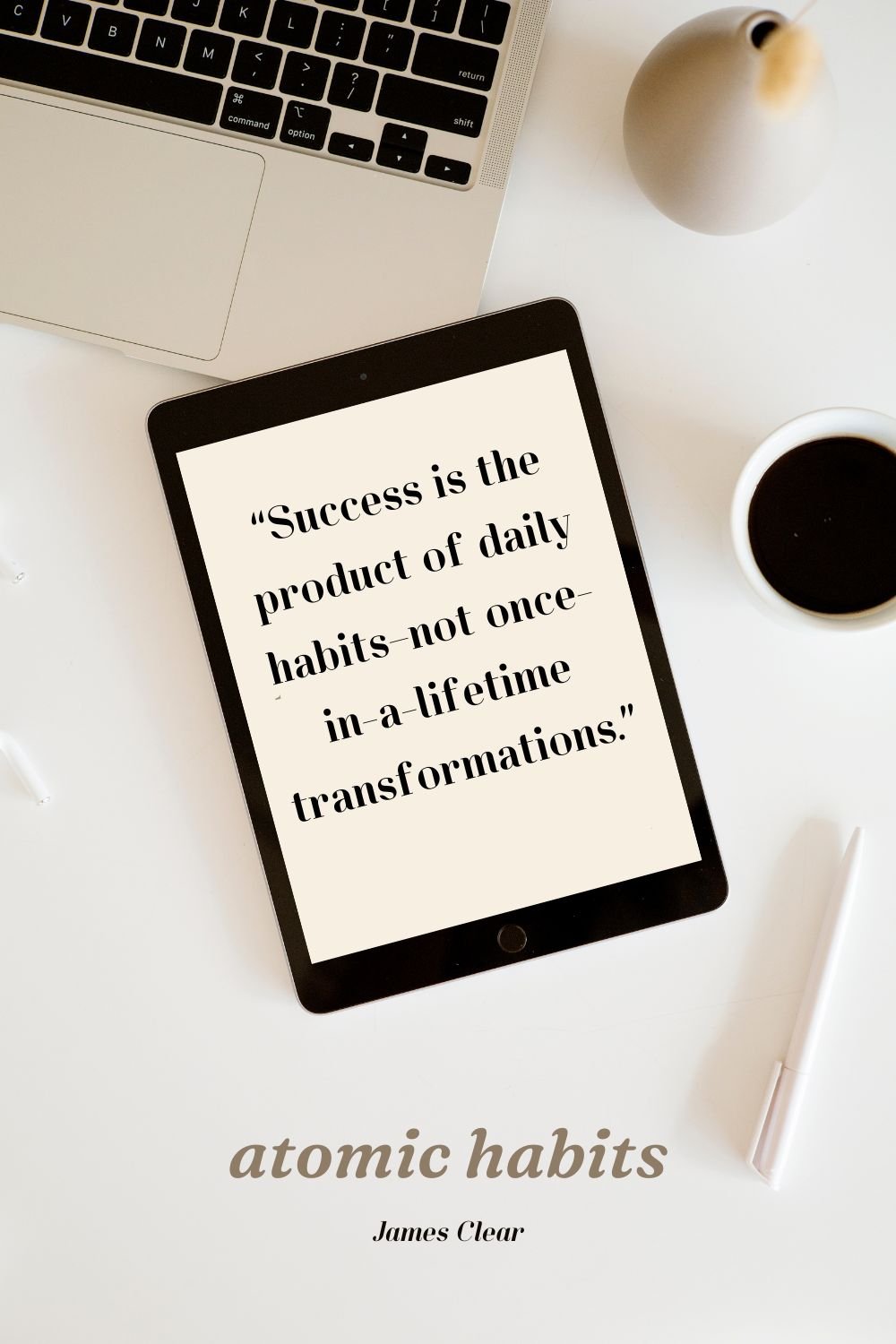
“Success is the product of daily habits—not once-in-a-lifetime transformations.”
James Clear’s message throughout the book is that the regular practice of a behaviour or routine will lead to a “compound interest of self-improvement”, and you’re casting a vote for the change that you want to be. But we also needed to be fully aware of what our habits are, and whether we need to change them.
“If you’re having trouble determining how to rate a particular habit, ask yourself: ‘Does this behavior help me become the type of person I wish to be? Does this habit cast a vote for or against my desired identity?’”
I want to be a better artist
I have my artist manifesto, and a life manifesto, similar to visions and goals, but how do I change to make these become a reality? Having the goal of “becoming a better artist” set at the beginning of the year does not benefit me at all if it’s just a plan. This is where Clear’s four rules come in handy.
There are, four rules to atomic habits, The Four Laws of Behavior Change. And they are:
Make it obvious
Make it attractive
Make it easy
Make it satisfying
If you want to get rid of a bad habit then the inverse would apply:
Make it invisible
Make it unattractive
Make it difficult
Make it unsatisfying
Make It Obvious
Make a list of good and bad habits. I took a few days to go over what I do (and didn’t do) every day and determined which habits negatively impacted my artist goals, and which had a positive impact and could be imporved. I always questioned myself, “what would an artist do?”
For example, here are a few from my list:
Good habit - showing up at the studio to work at least once a day for 1 hour regardless of whether I had a project. It could be just to do a few stitches. James Clear said it is always better to get your “reps” in. This reminds me of the story of the ceramics class in the Artist & Fear, where the students were divided into to 2 groups. One group was told they would be graded on how many ceramic pieces they made, while the other was told they would be assessed on quality only. The group that made more ended up with better quality as they learnt from their mistakes and had honed their skills each time. The other group was so fearful and were striving for perfection that their works were comparatively of less quality.
Good habit - I exercise everyday because it helps me relax and also give me energy to function as an artist. It’s also good for my health in general, although it would take a lot more to motivate me to get started on my exercise routine.
Good habit - I would love to start writing again in my journal. I used to do this regularly, but it somehow slipped away over the past 2 years.
Bad habit - scrolling on my phone as soon as I wake up, addicted to scrolling on social media. Gosh, this is a time stealer. I known it but I can’t stop!
Bad habit - react to deadlines when the deadline pops up
I then took the habits that significantly impacted my life and looked at how it could be improved (or eliminated!).
Stacking habits
According to the author:
“One of the best ways to build a new habit is to identify a current habit you already do each day and then stack your new behavior on top. This is called habit stacking.”
This means, for example:
a) if I wanted to be consistent with my exercise routine, I would do it immediately after another habit. In this case, I exercise after dinner and when the dishes are done; or
b) if I was keen on writing my art journal, I would schedule it as I was winding down my day. So I would do this right after my shower before bedtime.
The right environment
James Clear mentions that it’s always ideal to have the right environment for the habit to work. Having a television or laptop on in my bedroom would be a distraction to my art journal writing. I would need to reset my room so that I have the least path of resistance. So, away with the tele, hide the laptop and any other distractions, and place the journal and pen right next to my bed where it’s visible.
It’s the same in the studio. I have my sewing machine on my table (albeit covered) so that it reduces the friction between me and practicing my sewing. Many years ago, I would have the machine put in the cupboard, but it felt like a chore taking it out just to work on a project. Now it sits on my desk so that it reminds me to practice and improve my craft.
2. Make it Attractive
Have you ever noticed how we are always addicted to our phones? It’s because it gives us the rush of dopamine and it feels good! We have to make the good habits attractive the same way the internet does. Remember the art journal I was telling you about? What made it attractive to be writing it at the end of the day, is that it made me feel good. I was writing and letting go of events of the day into my journal, noting down thoughts for the next day, and didn’t have to worry about it before bedtime. By doing this, I could get a good night’s sleep, and feel refreshed by the next day.
Clear introduced a few journal prompts (and I threw in a few of my own) :
What did I do today (to help the future me)? What was the most important task today?
What did I learn? How did it help me become a better person?
What am I grateful for?
How did I share my work?
How do I feel?
How did I sleep last night?
3. Make it Easy
Is scrolling endlessly on your phone a bad habit of yours? It is one of mine! I initially start checking my social media for messages and updates, but I end up going down a rabbit hole and never knowing when to stop. It’s a time stealer, and I’m always telling myself, “another 10 minutes wouldn’t do me harm”, but when I look up, a whole hour has gone by! How many of you have been in this situation. It creeps into your studio time!
To get rid of bad habits, we need to make these more difficult to do, and in turn, this will create a good habit to increase your productivity in the studio.
So, it could mean:
Setting the wifi on a timer so that it will turn off at certain times of the day; or
Installing an app blocker so that I can’t access certain social media platforms during the day until a certain time; or
Switch off social media and messenger app notifications so you are not distracted from work.
the power of ritual - the 2 minute rule & the gateway habit
“The amount of time you have been performing a habit is not as important as the number of times you have performed it.”
In order to make a good habit you want to adopt be easy, Clear introduces two concepts: The Gateway Habit and the 2 Minute Rule.
I want to be able to start writing my art blogposts or update my website on a regular basis, but it sometimes becomes a chore, especially when my mindset is that I have to write it in one sitting. Even writing the journal was something that I didn’t look forward to before. The Gateway Habit is the introductory habit that makes the good follow-up habit become a ritual. Clear shares that Twyla Tharp gets up at 530am every morning and hails a taxi to get to the gym:
“The ritual is not the stretching and weight training I put my body through each morning at the gym; the ritual is the cab. The moment I tell the driver where to go I have completed the ritual.
“It’s a simple act, but doing it the same way each morning habitualizes it—makes it repeatable, easy to do. It reduces the chance that I would skip it or do it differently. It is one more item in my arsenal of routines, and one less thing to think about.”
So taking my examples of the website or blog updates, I now brew a certain type of tea in the morning. And this to me is a signal to me to do some updates at the computer. Once it is ritualised, the habit will become consistent. However, the updates are only done for a short spurt - 2 minutes. If I’m not getting into the flow of it then I will stop, but if I am, then I continue for about 30 minutes or more! The idea is to stop you from procrastinating!
4. Make it Satisfying
It is not easy to create a new routine, especially when life has taken a turn, and there are changes in your life. Clear mentions that in order to stick with good habits everyday, it is important to have visual proof of your hard work; some sort of habit tracker to measure your progress.
On the Stay Focused app that I use to block social media apps on my phone, it gives me a good reminder to why I shouldn’t go onto social media, as well as giving me an indication of how many times I have clicked it. The lower the number the better! I also use the project management software, Asana, to not only help me keep track of my projects, but it also helps me have an overview of what needs to be done. Previously, everything was in my head and jotted down in a calendar, but with this tool, I’m able to relieve some of that stress from my mind. I do love how they send unicorns flying across my screen whenever I tick off a task that’s done. It makes me feel good that I’m making progress !
My Atomic Habits so far?
It’s only been a month since I started. What has worked so far for me:
Identifying my good and bad habits was very eye opening. Writing them down gave me something to be accountable for. It does help to have your partner or someone who is close to you to give you inputs and provide an objective view.
Creating an environment that will help my good habits become better, and the bad ones “disappear”. I enjoy using the Stay Focused app and Asana to manage my time as prevent any time wasters. Be aware that if you do have a laptop at home, then you could be spending your time on there instead.
The 2 Minute rule really helped me get started on some habits, and stopped me from procrastinating.
Sometimes I do lapse especially when it comes to the bad habits. It’s not frequent, but I do worry that I will go back to my old ways. This is why Clear states that we have to recover quickly from any lapses. He says, “lost days hurt more than successful days”, and adds that just by showing up and doing the habit (no matter how badly it’s done), is better than not showing up at all.
Overall, I think this is a great book to get you going. Atomic Habits can be applied to all parts of our lives, and is useful in helping artists develop good habits, be it showing up in the studio to create artwork, developing new art skills or building the business side of your art practice. The key to success is to make the habits as easy and attractive as possible, and then repeat them on a daily basis so that it compounds over time. At the end of the day, we want to develop and improve our artistic skills, have a more consistent output, resulting in the creation of better quality of work.
I hope this works for you too!
“One good day does not mean you can coast tomorrow. You never have it fully licked. Making good choices is an endless process. Many areas of life that we value most—our relationships, our fitness, our craft—require a continual commitment.”

Read more